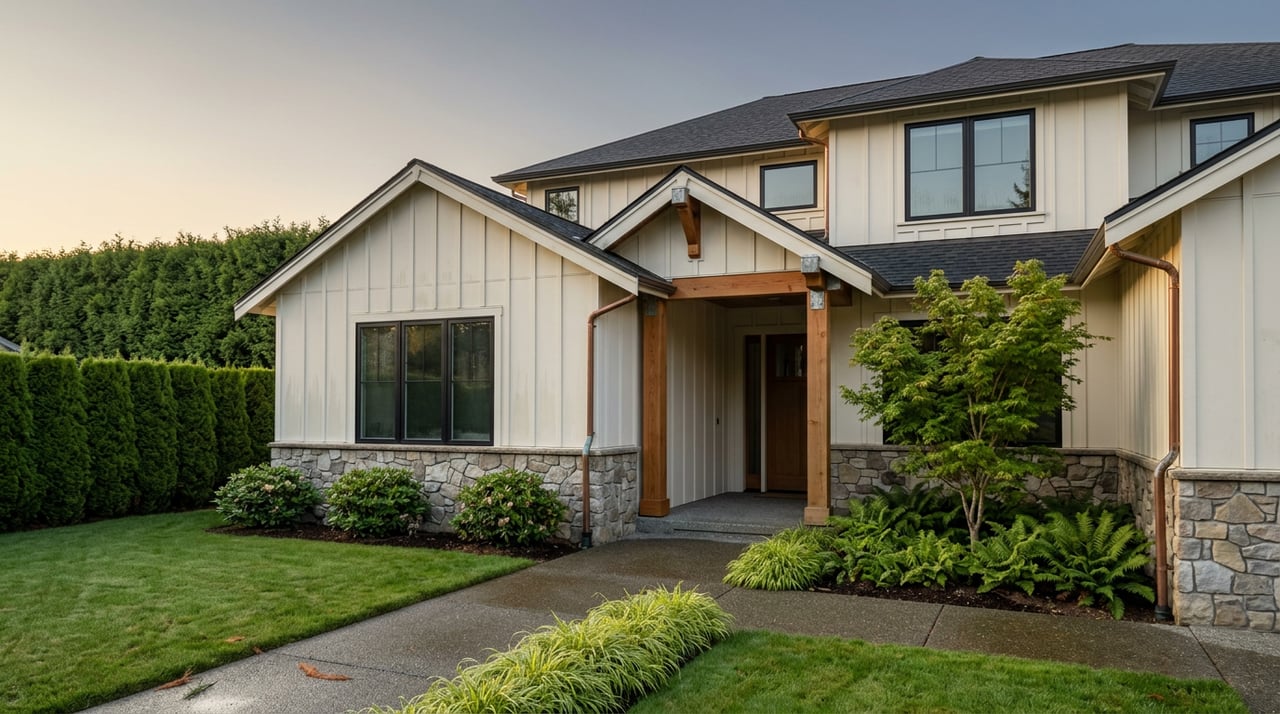
The Three Bellevue Housing Markets Hiding Behind One Median Price
September 10, 2026
September 10, 2026
In July 2026, the Northwest Multiple Listing Service put Bellevue's citywide median sold price at $1,560,000, up modestly from the prior report. Read that number on its own and you'd assume Bellevue is one market, moving one direction, at one pace. It isn't. In the same stretch of 2026, downtown condo sellers were cutting prices and watching listings sit for weeks, while a single-family home in Somerset that hit the market correctly priced was already pending before the open house sign came down.
Both of those things are true. They just aren't describing the same market. Bellevue in 2026 is really three separate housing markets stacked inside one median, and the gap between them has gotten wide enough that treating "Bellevue" as a single number will lead you to the wrong conclusion about your own price range.
Start with the strangest piece of evidence: nobody quite agrees on how tight Bellevue's inventory actually is right now. One analysis pegged citywide months of supply at roughly 0.33 in the second quarter of 2026, then climbing to about 4.5 by the third quarter. Another source, working from spring data, put it closer to 2.4 months. A third, published in late July, landed near 1.5 to 2 months. That's not sloppy research. It's what happens when a citywide average is built from three segments that are moving at completely different speeds, and each analyst happened to catch a different mix of listings on the day they pulled the number.
The segments themselves are more consistent than the averages built from them. Here's what's actually happening in each one as of the first half of 2026.
| Segment | Where you'll find it | What's happening right now | What it means for you |
|---|---|---|---|
| Condos and townhomes | Downtown Bellevue, Crossroads, Factoria | Inventory up roughly 50% year over year downtown, price per square foot down about 12% | Real negotiating room for buyers; sellers need to price to today's comps, not last year's |
| Core single-family (BSD boundaries) | Somerset, Newport Hills, Eastgate, Lake Hills | Well-priced homes still going pending in days, often with multiple offers | Sellers hold leverage here; buyers need financing sorted before they tour |
| Luxury ($2M and up) | West Bellevue, Clyde Hill, Medina | Entry pricing starts around $3M in Medina; deals move on timing and cash position | Mortgage rate swings barely register; this tier runs on its own calendar |
The condo numbers are the clearest of the three. Through the first half of 2026, downtown Bellevue saw roughly 90 condo closings compared with 112 over the same stretch of 2025, about 22 fewer sales even as more units sat on the market. Median condo sale price fell around 17% year over year, and months of supply climbed to roughly seven, up from about five a year earlier. Some of that softening traces to tech-sector layoffs and broader economic jitters earlier in the year that cooled buyer confidence specifically in the resale condo market. If you're shopping this segment, you're shopping a genuine buyer's market inside a city that's still described everywhere else as competitive.
Move a few miles from a downtown high-rise into a Somerset cul-de-sac and the story flips. This spring, homes in Somerset with a median sale price near $2 million were closing in just four to five days. The broader $1.4 million to $1.85 million single-family band has cooled slightly from its spring pace but remains the fastest-moving price tier in the city. Newport Hills and Eastgate, which offer school-district access without the water views, are showing similar patterns: correctly priced homes get multiple offers, and there's no meaningful slack for buyers to negotiate on.
Above roughly $2.15 million, the pace changes again, this time toward more room to negotiate, but not because demand has weakened. West Bellevue and Medina buyers are typically working with cash or substantial equity, so a quarter-point move in mortgage rates doesn't reshape their decision the way it does for a buyer financing a $1.5 million purchase. Entry pricing in Medina starts around $3 million, and waterfront estates on Lake Washington with private docks routinely trade between $5 million and $10 million or more. This tier is slower to transact simply because there are fewer buyers who qualify for it, not because it's cooling.
The segmentation doesn't stop at three neat categories. Even within condos, location inside the city splits the numbers further. NWMLS area data from February 2026 showed condo inventory west of I-405 sitting at just over nine months of supply, more than double the roughly 4.65 months recorded east of the freeway in the same month. A condo shopper comparing a listing in Bellevue's west-side map area to one on the east side isn't just comparing two buildings. They're comparing two different supply environments that happen to share a city name.
This is the part a national market report will never catch, because it requires knowing which side of the freeway a listing sits on, not just which city.
Bellevue also picked up a genuinely new piece of infrastructure this year. On March 28, 2026, Sound Transit opened the full 2 Line across Lake Washington, completing the world's first light rail crossing of a floating bridge and adding new stations at Judkins Park in Seattle and on Mercer Island. An Eastside-only segment running from Redmond to South Bellevue had already been operating since April 2024, but this was the piece that finally connected Bellevue directly to Seattle's rail network without a transfer.
That matters differently depending on which of the three markets you're shopping. For a downtown condo buyer, proximity to a station is now a real, testable commute variable, and it's one more reason that segment's softer pricing is worth a closer look rather than a pass. For a family looking at Somerset or Newport Hills, the rail line changes very little, because those buyers are choosing a school-district boundary and a yard, not a walk score. The infrastructure story is real, but it doesn't apply evenly across the city, which is itself more evidence for the same point: Bellevue rewards buyers who know which market they're actually in.
If you're comparing Bellevue to other Eastside cities using the median price alone, you're comparing an average of three unlike things. The more useful question is which of the three markets fits your budget and your reason for moving.
A buyer priced into the $600,000 to $900,000 range is shopping condos, almost certainly downtown, Crossroads, or Factoria, and should walk in expecting real negotiating leverage this year. A buyer in the $1.4 million to $1.85 million range is shopping the most competitive tier in the city and needs to be fully underwritten, not just pre-qualified, before touring anything in Somerset or Eastgate. And a buyer above $2 million should expect the process to move at a different rhythm entirely, one driven by relationships and timing more than list price.
Financing adds one more wrinkle worth knowing before you start. The 2026 conforming loan limit for King County is $1,063,750, well above the national baseline. That gives Bellevue buyers more room inside conventional financing than buyers in most of the country get, but it also means anyone targeting a single-family home in West Bellevue, Somerset, or most of the core BSD neighborhoods will still cross into jumbo territory, which can affect down payment requirements and underwriting timelines.
Is Bellevue a buyer's market or a seller's market right now? Both, depending on what you're buying. Condos favor buyers. Core single-family homes in the school district still favor sellers. Luxury runs on its own timeline regardless of who technically has leverage.
Does the light rail opening actually raise home values? It's too early to say with certainty, and it affects segments unevenly. Downtown and station-adjacent condo buyers have a new, real commute advantage to weigh. Buyers targeting single-family neighborhoods further from a station are unlikely to see much change in their calculus.
Why do different sources report such different inventory numbers for Bellevue? Because they're measuring different mixes of the same three markets at different moments. A citywide months-of-supply figure pulled during a week with heavy condo listings will look very different from one pulled during a week when single-family inventory dominates the count.
If you're trying to figure out which of these three Bellevue markets actually fits your budget, your timeline, and what you're hoping to get out of the move, that's exactly the kind of question worth working through with someone who watches these segments daily rather than guessing from a citywide average. Phil Rodocker and the team at Rodocker Group have spent decades reading Eastside micro-markets like this one. Contact us when you're ready to talk through where your number actually lands.
Stay up to date on the latest real estate trends.
Markets change—but experience doesn’t lose its value. With decades of hands-on knowledge in the Pacific Northwest, we guide every client with clarity, strategy, and a steady approach. Whether you're buying, selling, or investing, we focus on making the process smooth, informed, and aligned with what matters most to you.
THE RODOCKER GROUP
JOHN L. SCOTT REAL ESTATE 4735 NE 4TH ST RENTON, WA 98059